Analyzing Synchronization Between Core Hand Valuations and Progressive Staking Models Under Varied Virtual Dealer Configurations
Written by Avery Bauer · Nov 16, 2026
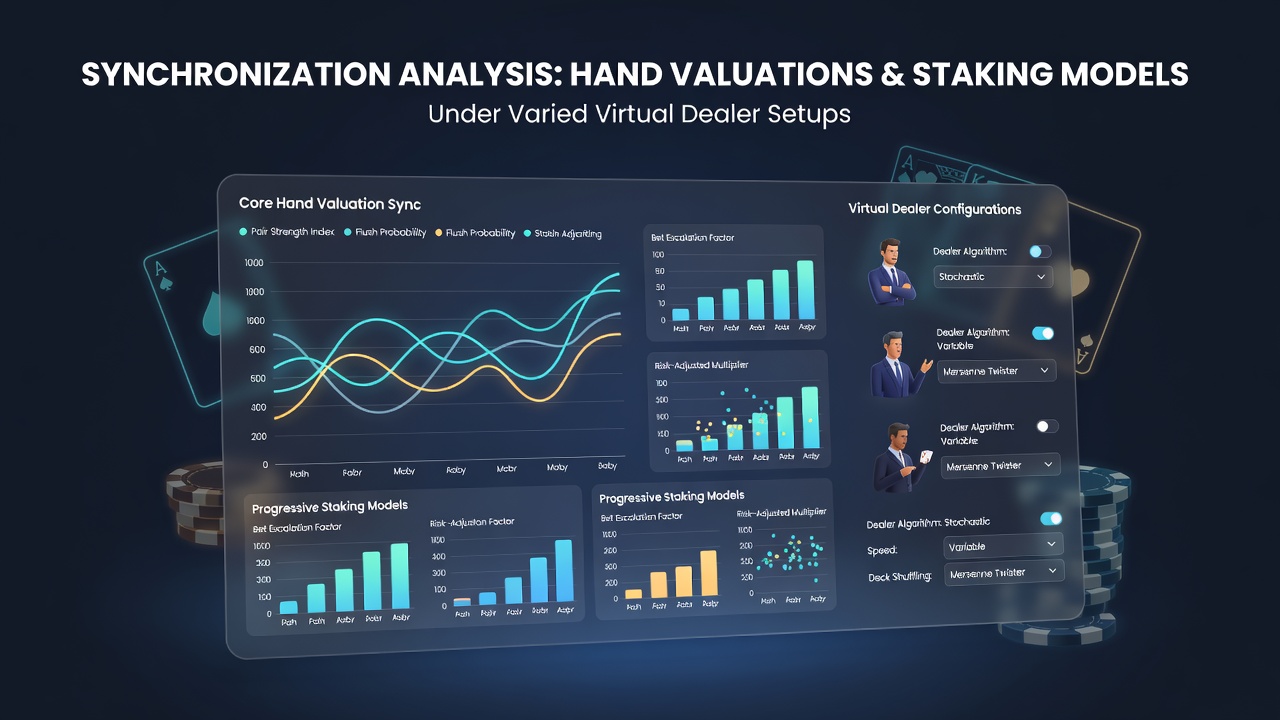
Analyzing Synchronization Between Core Hand Valuations and Progressive Staking Models Under Varied Virtual Dealer Configurations
Core hand valuations in blackjack assign numerical strength to player totals based on dealer upcards and remaining deck composition, while progressive staking models adjust wager sizes according to prior outcomes through sequences like doubling after losses or scaling after wins. Virtual dealer configurations alter these dynamics by varying parameters such as whether the dealer hits or stands on soft seventeen, the number of decks in play, and rules governing surrender or doubling. Observers note that synchronization emerges when valuation thresholds align with staking increments to maintain expected value stability across sessions.
Hand Valuation Fundamentals in Virtual Environments
Basic strategy charts quantify decisions for totals ranging from eight to twenty against dealer upcards from two through ace, with adjustments applied when deck penetration reaches specific levels in simulated play. Data from regulatory reports indicate that multi-deck virtual setups shift hard sixteen valuations by approximately 0.35 percent compared with single-deck equivalents, prompting earlier shifts in staking sequences. Researchers at institutions studying probability models have documented how these valuations interact with dealer hit-soft-seventeen rules, producing measurable differences in hand outcome distributions that staking algorithms must accommodate to avoid premature bet escalation.
Progressive Staking Mechanics and Alignment Points
Models such as the Martingale system double stakes after each loss until a win resets the sequence, whereas positive progressions increase bets following wins and reduce them after losses. Alignment occurs at valuation breakpoints where a hand's expected return exceeds the risk-adjusted stake size required by the progression step. Figures from industry analyses reveal that under virtual dealer configurations with six decks and stand-on-soft-seventeen rules, the synchronization window for a sixteen-versus-ten decision narrows by roughly twelve percent compared with hit-on-soft-seventeen setups, because dealer bust rates change and alter recovery probabilities within the progression ladder.
Those who model these systems find that incorporating deck-composition data into valuation matrices allows staking adjustments to track more closely with realized outcomes rather than fixed sequences alone. And because virtual environments permit rapid iteration across thousands of hands, patterns surface faster than in physical play, enabling precise mapping of valuation-to-stake correlations at different penetration points.

Impact of Dealer Configuration Variations
Configuration differences extend beyond the soft-seventeen rule to include restrictions on doubling after splits, blackjack payout ratios, and continuous-shuffle-machine simulations that reset deck composition at fixed intervals. Studies compiled by gaming control agencies show that continuous-shuffle setups compress the effective synchronization range for progressive models by limiting late-deck advantages, forcing earlier bet reductions when valuations drop below established thresholds. In contrast, shoe-based virtual games with deeper penetration allow staking sequences to extend further when positive counts coincide with strong hand valuations such as eleven against dealer five or six.
One analysis of European virtual platforms documented that dealer-stand-on-all-seventeen rules combined with no-double-after-split produced a 0.22 percent shift in overall return for players employing synchronized Martingale variants, because the altered bust frequency changed the timing of required stake resets. Observers tracking these metrics across jurisdictions note consistent patterns when configurations are held constant within each simulation batch.
November 2026 Regulatory Context and Modeling Adjustments
Upcoming changes scheduled for November 2026 in several North American markets will introduce standardized reporting requirements for virtual dealer parameters, requiring operators to disclose exact hit-or-stand rules and shuffle frequencies used in each game variant. According to preliminary guidance from the Nevada Gaming Control Board, these disclosures will enable more accurate calibration of progressive staking overlays against core valuations. Industry groups such as the European Gaming and Betting Association have released preliminary frameworks that emphasize data transparency, allowing modelers to test synchronization under the new configuration disclosures before implementation deadlines arrive.
Researchers examining pre-regulatory data sets have already begun mapping how these forthcoming standards affect the overlap between hand-strength breakpoints and progression step sizes, particularly in jurisdictions adopting dual-currency testing environments. The resulting models incorporate configuration flags that automatically adjust valuation tables when dealer rules switch, preserving alignment across the staking ladder without manual recalibration at each session start.
Conclusion
Coordination between hand valuations and progressive staking under varied virtual dealer configurations rests on precise mapping of expected returns to bet-step timing. Regulatory developments slated for November 2026 will supply the configuration data needed to refine these mappings further. Available studies and agency reports demonstrate measurable interactions that remain consistent when tested across standardized simulation batches, providing teh factual basis for continued model development in this area.