Decoding Insurance Bet Frequencies and Expected Values Across Varying Blackjack Deck Counts and Dealer Upcard Scenarios
Written by Ben Flores · Aug 22, 2026
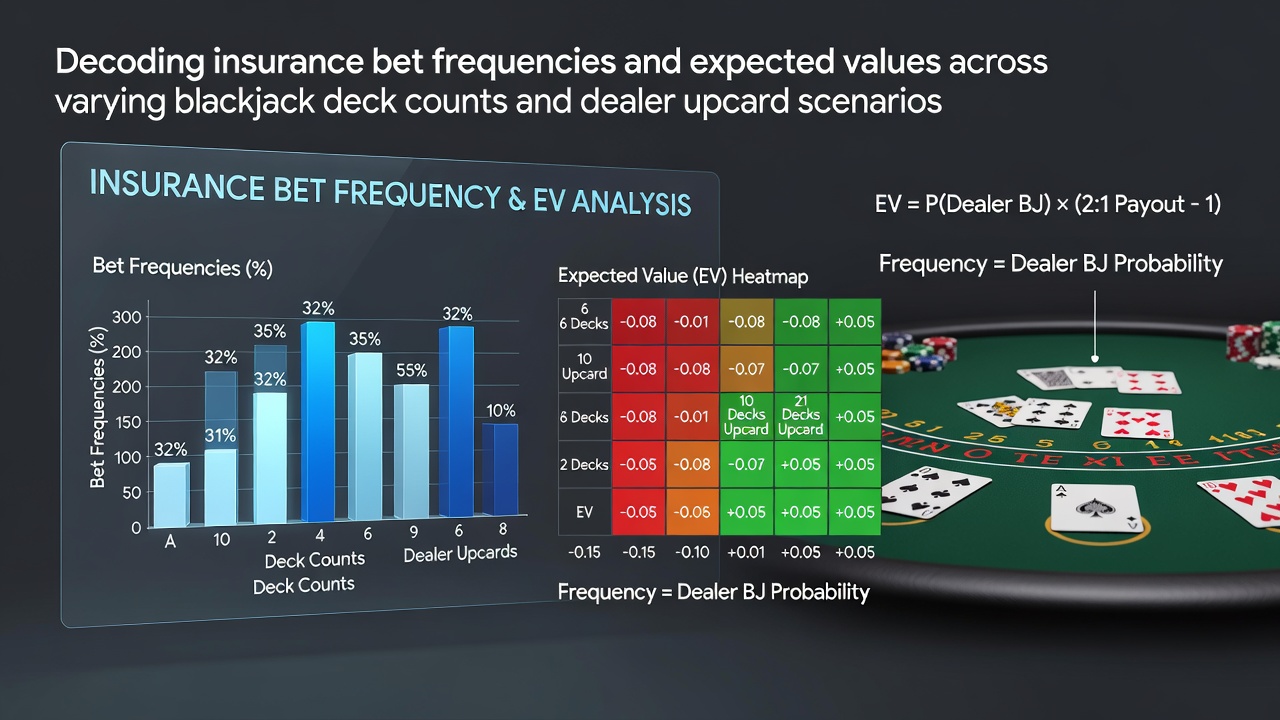
Decoding Insurance Bet Frequencies and Expected Values Across Varying Blackjack Deck Counts and Dealer Upcard Scenarios
Insurance bets in blackjack activate when the dealer shows an ace as the upcard, giving players the option to wager up to half their original bet that the dealer holds a ten-value card in the hole. Researchers have analyzed these side bets across single-deck, double-deck, and multi-deck games because the underlying probabilities shift with the total number of cards in play adn the specific composition at the moment the ace appears. Data from multiple studies indicate that the frequency of insurance opportunities remains tied to the appearance rate of aces, which stays consistent at roughly 7.7 percent in standard shoe games, while expected values fluctuate based on remaining tens and the deck count in use.
Core Mechanics of Insurance in Blackjack
Players place an insurance bet that pays 2 to 1 when the dealer completes a blackjack, and this payout structure creates a baseline expected value that hovers near negative 7.4 percent in most multi-deck formats according to probability tables compiled by gaming analysts. The bet resolves immediately after the dealer checks the hole card, so no further decisions occur once the outcome is known. Observers note that the insurance wager functions as a standalone proposition whose odds depend entirely on the ratio of tens to non-tens left in the shoe at that instant.
Frequency Patterns Across Deck Counts
Single-deck games produce insurance situations at the same ace frequency as larger shoes, yet the smaller card pool causes the remaining ten count to vary more sharply after each card is removed. Double-deck formats occupy an intermediate position where depletion effects appear earlier than in six-deck or eight-deck games but later than in single-deck play. Multi-deck shoes, which dominate casino floors today, deliver insurance opportunities at a steady rate because the large card inventory buffers against rapid composition changes. Figures from industry reports show that players encounter insurance decisions approximately once every thirteen hands on average regardless of deck number, although the conditional probability of dealer blackjack given an ace upcard changes measurably with fewer decks remaining.
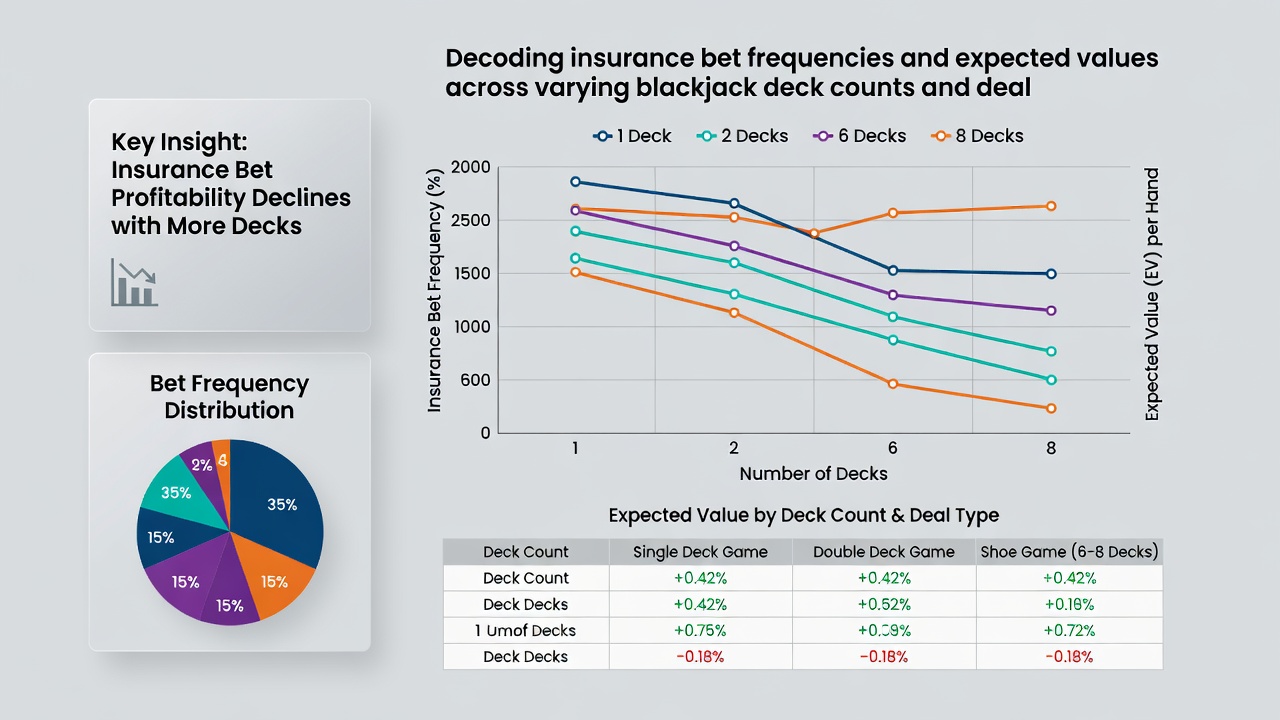
Analysts tracking six-deck and eight-deck games report that insurance appears slightly more often in later rounds once penetration increases, because the proportion of aces dealt early leaves a marginally higher density of tens in the remaining cards. Single-deck tables, by contrast, allow for quicker swings in the ten-to-ace ratio, which in turn affects how frequently the insurance bet carries positive expectation when card counting systems are applied.
Expected Value Calculations by Deck Count
In an eight-deck shoe the initial insurance expected value sits at approximately negative 7.4 percent when the dealer ace appears, and this figure improves only when the true count rises above +3 according to standard Hi-Lo calculations. Double-deck games begin with a similar negative expectation yet reach positive territory at a lower true count threshold because each card removed carries greater weight. Single-deck play produces the most volatile expected values, where an insurance bet can flip to positive expectation even at moderate counts because the finite card supply amplifies the impact of early removals. Researchers have documented that the exact break-even point for insurance shifts by roughly 0.5 true count units between single-deck and eight-deck configurations, a difference confirmed through large-scale simulations run by university gaming laboratories.
Dealer upcard scenarios beyond the ace receive separate treatment in basic strategy charts, yet insurance remains exclusive to the ace because only then does the dealer offer the side bet. When the dealer shows other upcards, players evaluate standing, hitting, or doubling decisions instead, and those choices carry their own expected values that also vary with deck count. Studies indicate that the insurance decision interacts with overall hand strategy most noticeably in single-deck and double-deck environments where early count deviations influence multiple subsequent plays.
Dealer Upcard Interactions and Scenario Variations
Although insurance applies solely when the upcard is an ace, analysts examine how the broader distribution of upcards affects overall game texture and the timing of insurance opportunities. In games where tens appear more frequently as upcards, the shoe tends to contain a slightly lower density of remaining aces later, which indirectly reduces insurance frequency in later rounds. Conversely, ace-rich shoes increase the rate of insurance decisions while simultaneously altering the expected value of the main hand. As of August 2026, updated simulation software used by several North American research groups has allowed finer mapping of these interactions across penetration levels, revealing that the combined effect of deck count and upcard distribution produces measurable differences in long-run return for players who track insurance situations precisely.
Canadian provincial gaming data and reports from the Nevada Gaming Control Board both illustrate that multi-deck configurations maintain more stable insurance frequencies across an entire shoe, whereas single-deck and double-deck tables exhibit greater round-to-round variance. This stability matters for players who adjust bet sizes based on count because the insurance wager itself can serve as a count indicator in certain systems.
Conclusion
Insurance bet frequencies remain anchored to ace appearance rates across all deck counts, while expected values respond sensitively to the number of decks in play and the running count at the moment of decision. Single-deck and double-deck formats reach favorable insurance conditions at lower thresholds than six-deck or eight-deck shoes, and dealer upcard patterns exert secondary influence on the timing and profitability of these side bets. Comprehensive probability models continue to provide the clearest guidance for understanding how these variables interact under real casino conditions.