How Regional Variations in Blackjack Payout Structures Influence Strategic Choices Across Different Gaming Jurisdictions
Written by Noah Meier · Aug 24, 2026

How Regional Variations in Blackjack Payout Structures Influence Strategic Choices Across Different Gaming Jurisdictions
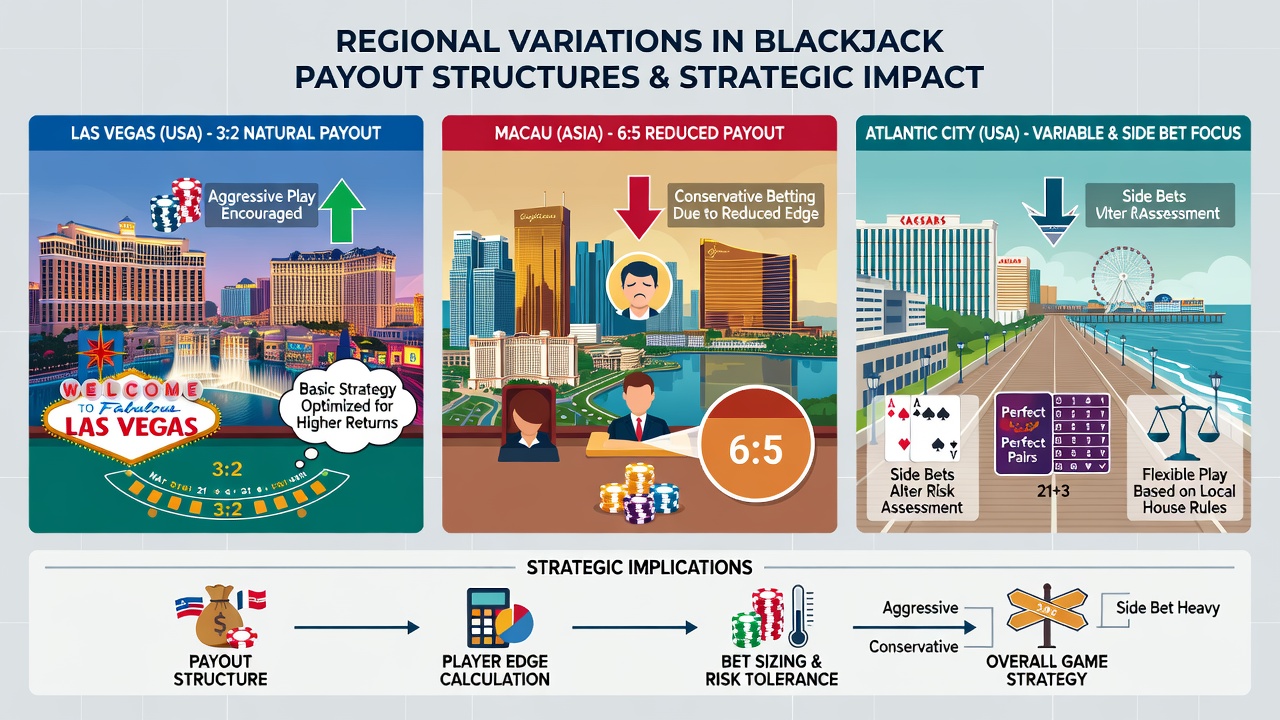
Data from multiple gaming authorities reveals that blackjack payout structures vary significantly across regions, and these differences directly shape player decisions on basic strategy charts, bet sizing, and game selection. In many North American markets, the shift from traditional 3:2 blackjack payouts to 6:5 versions has altered expected value calculations, while European and Asian jurisdictions maintain distinct rules on dealer actions and player options that require adjusted approaches to doubling and splitting.
North American Payout Differences and Their Effects
Nevada casinos have long operated under rules tracked by the Nevada Gaming Control Board, where most Strip properties now advertise 6:5 blackjack on lower-limit tables, whereas downtown venues and some off-Strip locations continue offering 3:2 payouts. This variation forces players to recalculate their advantage because the reduced payout on natural blackjacks increases the house edge by roughly 1.4 percent compared with standard tables. Strategic adjustments follow immediately as card counters reduce their spread ratios on 6:5 games to compensate for the lower return, and basic strategy practitioners avoid certain marginal hands that become unprofitable under the tighter payout.
Atlantic City properties regulated by the New Jersey Division of Gaming Enforcement present another pattern, with many tables maintaining 3:2 payouts but imposing stricter rules on doubling after splits and surrender options. Observers note that these constraints lead players to tighten their splitting thresholds on pairs such as 9-9 and 7-7, since the inability to recover from a poor split reduces overall expected value. Data released in August 2026 by regional gaming reports shows a measurable decline in table occupancy at 6:5 venues during peak hours, suggesting players actively migrate toward jurisdictions that preserve higher payouts.
European and Asian Rule Variations
Continental European casinos, often governed by bodies such as the Malta Gaming Authority, typically enforce a no-hole-card rule combined with 3:2 payouts and mandatory dealer stand on soft 17. These conditions prompt players to adopt more conservative doubling strategies on hard totals because the dealer retains a higher chance of improving after checking for blackjack. Research from European gaming studies indicates that the absence of early surrender further shifts optimal play away from aggressive risk-taking on stiff hands like 15 and 16 against a dealer ten.
Macau and other Asian markets operate under frameworks established by the Macau Gaming Inspection and Coordination Bureau, where many tables pay 3:2 yet feature continuous shuffling machines and limited deck penetration. Players in these environments reduce their reliance on card counting systems and instead focus on table selection criteria that emphasize payout consistency and rule sets allowing double after split. Figures from industry analyses reveal that strategic deviations in these jurisdictions center more on bet placement timing than on precise count-based adjustments, given the mechanical limitations imposed by shufflers.
Strategic Adaptation Across Borders
Players who travel between jurisdictions compile multiple basic strategy charts tailored to each payout structure, because a single memorized chart produces suboptimal decisions when the blackjack payout drops from 3:2 to 6:5. Researchers at institutions studying gambling mathematics have documented that the frequency of insurance bets rises in 6:5 environments as counters seek to offset the diminished natural payoff, while surrender rates increase in markets that permit late surrender against dealer aces. These behavioral shifts appear consistently in observational data collected from casino floors in both the United States and Europe.
Bankroll management practices also diverge according to regional payout norms. In areas where 3:2 remains standard, players allocate larger session bankrolls because the higher return on blackjacks supports longer play periods before reaching loss limits. Conversely, in 6:5 dominant markets, participants shorten their session lengths and lower their unit bets to maintain the same risk of ruin percentages reported in mathematical models. Reports from the Canadian Gaming Association highlight similar patterns in provincial casinos, where payout variations prompt operators to publish rule cards that explicitly list payout ratios so players can adjust their strategies before sitting down.
Conclusion
Regional payout structures continue to dictate precise modifications to blackjack strategy across every major gaming jurisdiction. Data from regulatory bodies and academic sources demonstrates that players respond by altering their basic strategy indices, bet spreads, and game selection criteria in direct response to whether a table pays 3:2 or 6:5, combined with local rules on doubling, splitting, and surrender. As new regulatory updates emerge, those who track these variations maintain separate strategy references for each market they frequent.